Practice Area · Tax Resolution
The IRS has a lawyer.
Now you do too.
Representation before the IRS and the United States Tax Court by a licensed Texas tax attorney with 40+ years in practice — from first notice through final resolution, and through litigation when the administrative path is not enough.
Why this practice exists.
Most taxpayers in trouble with the IRS never speak to an attorney. They call a national tax-relief firm, get routed to an intake representative, hear a quote, pay a retainer, and then spend months wondering why nothing is happening. The answer is usually the same: the intake representative was a salesperson, the "case manager" is not a licensed practitioner, and the firm's operating model is designed for volume, not outcomes.
Lozano Tax Resolution exists to reverse every element of that model. Your first call is with a licensed Texas tax attorney. Your representation begins, not with a contract signed and filed away, but with a Form 2848 Power of Attorney filed with the IRS the same day — often within hours of engagement. When the IRS is actually notified of counsel, the mechanics of your case change.
Four arguments worth making.
One. The "free consultation" is a sales call.
Intake representatives at national tax-relief firms do not hold CAF numbers. They do not hold PTINs. They do not have access to the IRS Practitioner Priority Service. They cannot see the IRS file. When you speak to them, you are speaking to someone whose job is to sell you a retainer — not to analyze your situation. The "free" thing is a sales call, not an analysis.
Two. Representation slows the IRS down.
Filing a Form 2848 Power of Attorney does more than permit communication — it requires it. Once an attorney is on record, revenue officers must route contact through counsel. Collection timelines that felt imminent become negotiable windows. Levy notices that would have been issued get held. Hearings that would have defaulted get conducted. The IRS does not stop — no lawyer can credibly promise that — but representation meaningfully slows the pace at which the agency moves against you.
Three. Lozano files immediately.
When you retain this firm, the Form 2848 is filed the same business day. The call to the IRS Practitioner Priority Service is placed the same business day. Norris does this personally, not a paralegal or an intake manager. The entire purpose of the first 24 hours is to interpose counsel between you and the agency as quickly as procedurally possible.
Four. Not everyone can even hold the Power of Attorney.
Under Treasury Circular 230, only three categories of practitioner are eligible to be granted Form 2848 authority: attorneys, Certified Public Accountants, and Enrolled Agents. "Tax resolution specialist," "senior case analyst," "IRS settlement officer" — these are marketing titles. They carry no authority under Circular 230. If the person handling your matter is not an attorney, CPA, or EA, they are not authorized to represent you before the IRS at all.
Resolution paths, explained without the sales pitch.
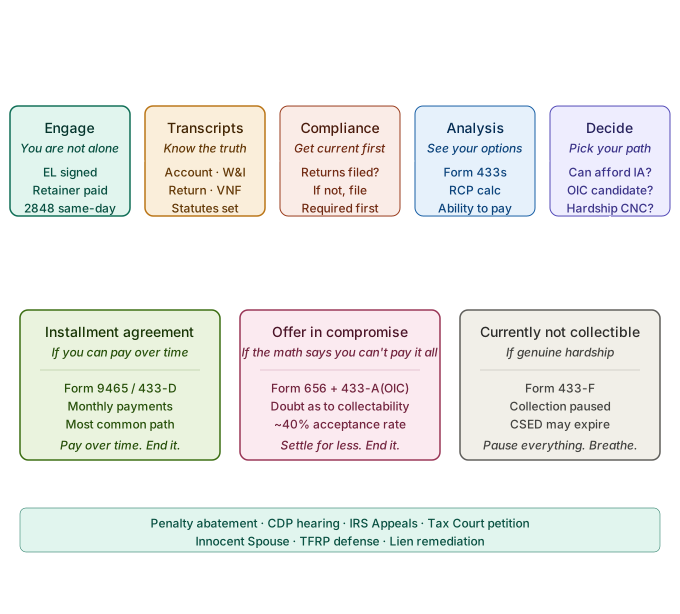
Every taxpayer with an IRS balance has a finite set of resolution paths available to them. The right path depends on the specific facts: total liability, years involved, current income and expenses, asset position, whether returns are filed, and what the IRS has already done administratively. A responsible analysis examines all of them before recommending one.
Offer in Compromise
Settlement of an IRS liability for less than the full amount owed, usually dramatically less. The IRS accepts roughly 40% of offers received; rejected offers are typically rejected for the same handful of reasons. Eligibility depends on a strict calculation of reasonable collection potential. An OIC is not a negotiation in the ordinary sense — it is a formula applied to a financial picture. The work is in preparing the package so the formula returns the right answer.
Installment Agreement
The most common resolution path. Four main types: guaranteed, streamlined, partial pay, and regular. The difference between a well-structured installment agreement and a poorly-structured one is measured in years and tens of thousands of dollars. The IRS has an internal formula for what it considers an affordable monthly payment; taxpayers who submit payment plans based on what they think they can afford routinely find themselves locked into agreements they cannot sustain.
Currently Not Collectible
A status that pauses enforcement when a taxpayer genuinely cannot pay without financial hardship. The debt does not go away — but the levies, garnishments, and collection letters stop while the status is in effect. The right circumstance for CNC is when the taxpayer's current financial position is materially worse than their long-term earning trajectory suggests it should be. A thoughtful representative considers whether the Collection Statute Expiration Date might pass during the CNC period, in which case the liability extinguishes entirely.
Penalty Abatement
Penalties often exceed the underlying tax. The IRS recognizes two main grounds for penalty relief: First-Time Abatement (administrative, available to taxpayers with a clean prior compliance history) and Reasonable Cause (substantive, available where the taxpayer can document why the failure occurred despite ordinary business care and prudence). A complete penalty strategy typically uses both grounds across different tax years.
Collection Due Process hearing
A right triggered by specific IRS notices — the final notice of intent to levy (LT11 / Letter 1058) and the Notice of Federal Tax Lien Filing. The taxpayer has 30 days to request a hearing. A CDP hearing is an administrative forum where collection alternatives can be proposed, the underlying liability can be challenged in certain circumstances, and the administrative record is built for any subsequent Tax Court petition. Missing the 30-day window forecloses the hearing and limits later options significantly.
Innocent Spouse Relief
Relief available to a spouse who signed a joint return but can establish that the understatement or underpayment was attributable to the other spouse, and that holding the requesting spouse liable would be inequitable. Three statutory bases exist under IRC §6015. Most innocent spouse cases that succeed are won on facts carefully documented at the administrative stage, not arguments raised late.
Trust Fund Recovery Penalty defense
When a business fails to pay over employment taxes withheld from employees, the IRS can assess the unpaid trust fund portion personally against the "responsible persons" who willfully failed to pay. The assessment is devastating because it survives the business's bankruptcy and attaches to individuals. Defense turns on the two statutory elements — responsibility and willfulness — and the factual record built during the Revenue Officer's interview.
Audits and examinations
Correspondence audits, office audits, and field audits each require different preparation. The worst mistake a taxpayer can make in an audit is treating it as a conversation. An audit is an adversarial proceeding where every statement becomes part of the record. Representation at audit matters because the audit stage is often where cases are won or lost — before anyone has started arguing about the law.
IRS Appeals
Formal written protest to the IRS Office of Appeals, invoked after an examination report the taxpayer disagrees with. Appeals is independent of the examination function and is empowered to settle on the "hazards of litigation" — a standard not available to examiners. A well-prepared protest identifies the legal issues, cites the authorities, and frames the factual record to support settlement. Many cases that would fail at exam succeed at Appeals.
United States Tax Court
The only federal court where a taxpayer can challenge a proposed IRS deficiency without first paying the tax. A petition must be filed within 90 days of a statutory notice of deficiency (150 days if the taxpayer is outside the United States). Missing the deadline forecloses Tax Court jurisdiction permanently. Most Tax Court cases settle before trial — but the settlement leverage comes from the petition being filed in the first place, and by counsel trained in Tax Court rules of evidence and procedure.
Frequently asked questions.
How is a tax attorney different from an Enrolled Agent or CPA?
All three — attorneys, CPAs, and Enrolled Agents — can represent taxpayers in administrative IRS matters under Circular 230. In Tax Court, attorneys are admitted on motion upon showing good standing with any state bar, while non-attorneys must pass a rigorous written examination covering Tax Court rules, federal taxation, federal rules of evidence, and legal ethics. Tax Court advocacy is therefore overwhelmingly handled by attorneys. Separately, only attorneys carry full attorney-client privilege; the statutory privilege available to CPAs and EAs under IRC §7525 is materially narrower and does not apply in criminal matters. See Why a Tax Attorney for the complete comparison.
What is the fastest way to find out where I stand?
The $105 Transcript Analysis. We pull your IRS account transcripts, review every assessment and deadline on record, and prepare a written analysis with specific recommendations. Response within one business day. Written analysis delivered within 2–3 business days. Fee credited toward engagement if you retain the firm.
What if my situation is urgent — an active levy or garnishment?
Call directly at (214) 531-3014. For active enforcement, Lozano Tax Resolution commits to same-business-day response. Do not wait for a form submission. An active levy moves faster than email.
Can representation slow IRS collection action?
No attorney can promise to stop IRS enforcement. Representation slows it down. Once Form 2848 is on file, collection timelines extend, revenue officers must route through counsel, and deadlines that felt imminent become negotiable windows. In many cases, representation moves a levy from "this week" to "not at all" — but that outcome is earned through the work, not promised at intake.
Do you take cases outside Texas?
The U.S. Tax Court is a federal court with nationwide jurisdiction, so tax-resolution matters in IRS administrative proceedings and Tax Court can proceed for clients anywhere in the United States. Texas-specific matters — entity formation, estate planning, real estate — are limited to Texas jurisdiction or matters with Texas nexus.
What does full representation cost?
Depends on the path. Representative ranges: installment agreements $2,500–$6,000; Offers in Compromise $5,000–$15,000; CDP hearing $3,500–$7,500; IRS Appeals $5,000–$12,000; Tax Court S-case $7,500–$15,000; Tax Court regular case $15,000–$50,000+; TFRP defense $7,500–$25,000. Flat fees where scope permits. Payment plans available.