$2,982
Monthly income cap for a single applicant (2026)
Nursing home care in Texas commonly costs more than most retirees' entire monthly income — and Medicare does not pay for long-term custodial care. Medicaid does, but only under strict financial rules. The purpose of Medicaid planning is simple: qualify lawfully, as early as the rules allow, while protecting a spouse and preserving what the family can lawfully keep.
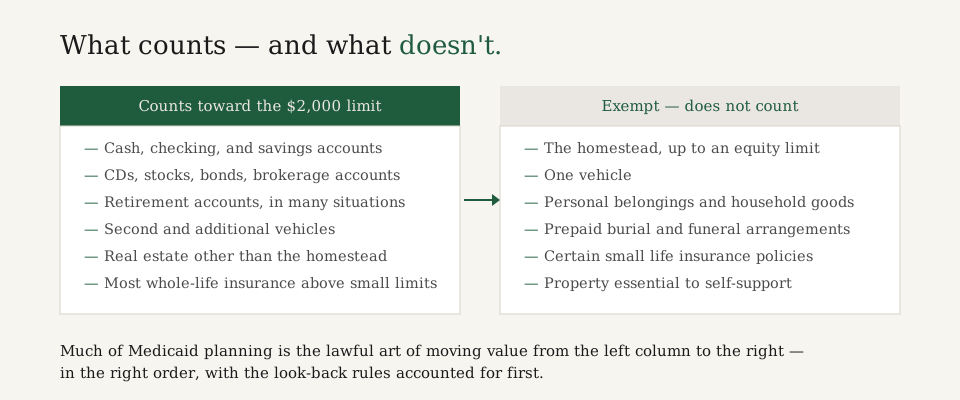
For nursing home Medicaid and the STAR+PLUS home-and-community-based waiver, Texas applies both an income test and an asset test:
Figures are 2026 amounts and adjust annually — verify current numbers with Texas HHSC before acting.
"Countable" is the key word on the asset side. Some assets don't count at all: the homestead (up to an equity limit), one vehicle, personal belongings, most prepaid funeral arrangements, and certain other exempt property. Much of Medicaid planning is the lawful art of converting countable assets into exempt or protected ones.
Texas is one of a minority of states with a hard income cap. If an applicant's gross monthly income is even one dollar over the cap, they are ineligible — no matter how far short that income falls of an actual nursing home bill. The fix is a Qualified Income Trust (QIT), universally known as a Miller Trust.
Each month, income above the cap is deposited into the QIT. Income routed through the trust doesn't count toward the cap, restoring eligibility. The trust funds are then paid out under Medicaid's rules — the resident's personal needs allowance (currently $75 per month in Texas), any spousal income allowance, and the balance toward the cost of care. At death, anything left in the QIT reimburses the state.
Federal and Texas law never intended Medicaid eligibility to impoverish a healthy spouse. Two protections do most of the work:
Beyond these baseline protections, Texas law permits additional planning for married couples that can often protect substantially more — but the strategies are technical and fact-specific, and timing matters enormously.
When someone applies for nursing home Medicaid, Texas reviews every financial transfer made in the previous 60 months. Gifts and below-market sales during that window trigger a penalty period — a stretch of time during which Medicaid will not pay for care, calculated from the amount transferred.
Two misconceptions cause most of the damage:
With time, options are widest: irrevocable Medicaid asset protection trusts can move assets outside the look-back window entirely; long-term care insurance can be evaluated; documents can be drafted to give agents full planning authority.
Even with a loved one already in a facility, meaningful protection is usually still possible — through spousal protections, exempt asset conversions, caregiver agreements, certain compliant annuities, and careful QIT administration. Families are routinely told by facility staff that the only path is spending everything. That is almost never the whole truth.
Through the Medicaid Estate Recovery Program (MERP), Texas may file a claim against the probate estate of a Medicaid recipient after death — most often against the homestead. Texas recovery reaches only the probate estate, and several exemptions and hardship waivers apply, which is why Medicaid planning and estate planning must be done together: tools like transfer-on-death deeds and Lady Bird deeds can generally keep the home out of MERP's reach while preserving Medicaid eligibility during life.
Not during life — the homestead is generally exempt while the recipient or spouse lives there or intends to return. The real exposure is estate recovery after death, which planning can generally prevent.
Only briefly. Medicare covers up to 100 days of skilled rehabilitation after a qualifying hospital stay, with copays after day 20 — and nothing for long-term custodial care. Families are often blindsided when the skilled days run out.
Yes. Arranging a family's affairs to qualify under the rules Congress and Texas wrote is as lawful as arranging them to minimize taxes. What's illegal is hiding assets or lying on an application — which is precisely what proper planning makes unnecessary.
Bring a rough picture of income, assets, and the care situation. The firm maps the realistic options — proactive or crisis — before anything is spent or transferred.
Contact the Firm