A nursing home costs more than most families can pay. Texas law has answers.
Long-term care in Texas routinely runs six figures a year. Medicaid is how most families ultimately pay for it — and qualifying without losing the home, the savings, or the well spouse's financial footing is legal work. Norris Lozano advises Texas families through that work, from the first eligibility analysis to an approved application.
The fear most families arrive with is that Medicaid means losing everything. It doesn't have to. Texas law provides real, established tools: the homestead can be protected, a healthy spouse living at home is entitled to keep resources and income, and assets can often be restructured so a family qualifies within the program's limits while preserving what a lifetime of work built. What those tools have in common is that they reward planning and punish improvisation — the rules around gifting, timing, and titling are unforgiving when steps are taken in the wrong order.
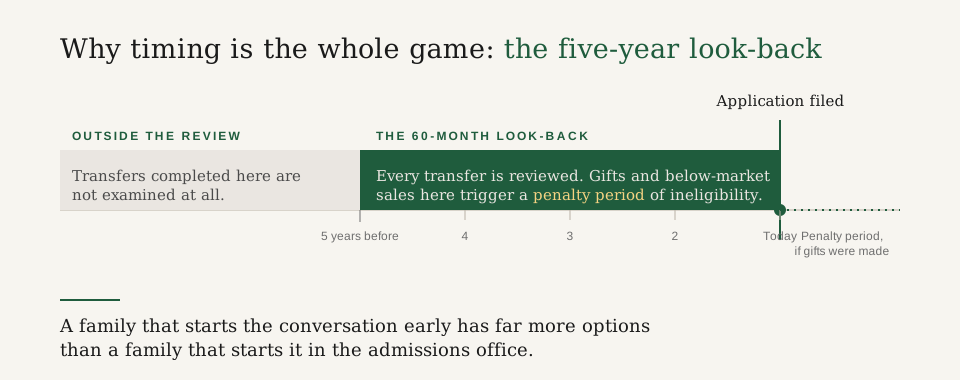
This is also work where the line between good planning and expensive mistakes is often a five-year one. Medicaid reviews financial transfers going back five years from the application date, and transfers made without value received — including gifts to children and even charitable gifts — can trigger a penalty period of ineligibility. A family that starts the conversation early has far more options than a family that starts it in the admissions office.
"The families who keep the most are the ones who ask the earliest. The rules reward planning — and they are unforgiving about order of operations."
What the practice covers.
Medicaid qualification & application
Eligibility analysis against Texas income and asset limits, preparation of the application, filing with Texas Health and Human Services, and follow-through until a decision issues — including responding to requests for additional information that stall most self-filed applications.
Asset restructuring & spend-down
Restructuring finances so a family qualifies within program limits while preserving wealth for the next generation — done in the right order, with the five-year look-back and transfer-penalty rules accounted for before any asset moves.
Protecting the spouse at home
Texas law entitles the spouse remaining in the community to protected resources and income when the other spouse enters care. Planning for the well spouse — including community-property survivorship agreements — is often the single most consequential piece of the file.
Protecting the home
The Texas homestead occupies a favored position in both Medicaid eligibility and estate recovery. Enhanced life estate deeds — known as Lady Bird deeds — and related titling work can keep the home in the family rather than in the state's recovery claim after death.
Powers of attorney & representation
Durable powers of attorney and authorized-representative designations drafted so the right family member can lawfully act — before capacity declines to the point where a court-supervised guardianship becomes the only remaining option.
Caregiver agreements
When an adult child provides real care, a written, reasonable, properly documented caregiver agreement lets the family compensate that work without Medicaid later treating the payments as disqualifying gifts. Informal arrangements are exactly what the look-back review penalizes.
Why an attorney
Filing is paperwork. Planning is law.
Anyone can download a Medicaid application. The value is in everything that happens before it's filed: knowing which assets count and which are exempt, which transfers are safe and which trigger penalties, how the home should be titled, what the well spouse is entitled to keep, and how estate recovery works after death. Those are legal judgments with legal consequences, and getting them wrong is usually discovered at the worst possible moment — after the transfer is made, after the deed is signed, after the application is denied.
At this firm, that judgment comes with an attorney-client relationship and the privilege that attaches to it from the first conversation. Norris Lozano drafts, reviews, and takes professional responsibility for the legal work — the deeds, the powers of attorney, the agreements, the plan itself.
How the work gets done
An attorney's judgment, a team's follow-through.
The firm's Medicaid work runs in collaboration with Medicaid Filing Connections, whose team — led by Dr. Amy Arp, author of Senior Transitions 101 — coordinates the practical side of a long-term-care transition: eligibility analysis, application preparation and filing, facility coordination, and the family conversations that surround a placement. Norris provides the legal advice and takes professional responsibility for every legal matter.
Every question families meet, in the order they meet it.
Elder law isn't one area of law — it's every legal question a family encounters as a parent or spouse ages. This guide walks through those questions the way families actually meet them: by moment, not by statute. Not sure where to start? Pick the sentence that sounds familiar.
The best time to plan was five years ago. The second-best time is today.
Whether a nursing home decision is years away or weeks away, the first step is the same: a direct conversation with an attorney about what your family owns, what Texas law protects, and what order to do things in.