The benefits families overlook: VA pension, Medicare realities, and how programs fit together
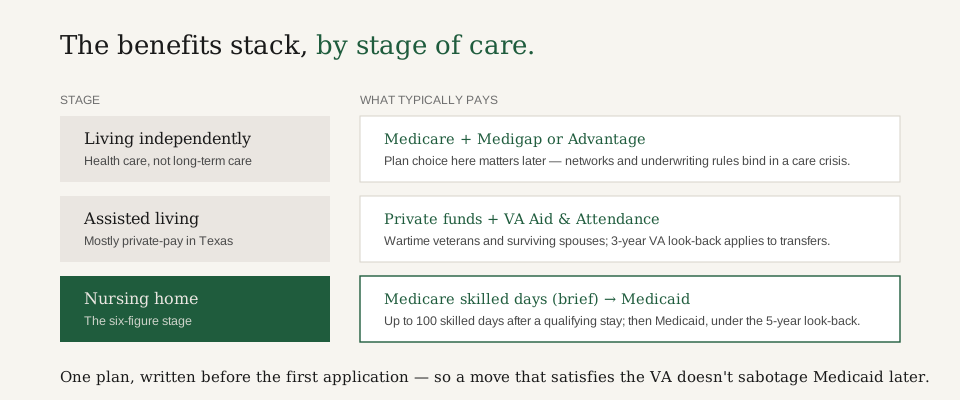
Paying for care is rarely one program — it's a stack: Social Security, Medicare, sometimes a VA pension, sometimes Medicaid, each with its own rules and each affecting the others. Benefits counseling is the discipline of stacking them correctly, in the right order, without one application sabotaging another.
VA Aid & Attendance: the pension many veterans never claim
Wartime veterans — and their surviving spouses — may qualify for a needs-based VA pension with an Aid & Attendance enhancement when they need help with activities of daily living, are housebound, or reside in assisted living or a nursing home. The benefit pays a monthly cash amount that can meaningfully offset assisted living costs — a setting Texas Medicaid covers only in limited ways.
The basic eligibility framework
Service: generally at least 90 days of active duty with at least one day during a designated wartime period, and a discharge that was not dishonorable.
Medical need: a demonstrated need for the aid and attendance of another person, or housebound status.
Financial need: the VA applies a net-worth limit (adjusted annually) that counts assets plus annual income, with unreimbursed medical and care expenses — including assisted living charges — deductible from income.
Since 2018, the VA has applied its own three-year look-back to asset transfers, with penalty periods for gifts made to get under the net-worth limit. VA planning and Medicaid planning must therefore be coordinated: a transfer that works for VA can still be penalized by Medicaid's five-year look-back later.
In plain termsIf a parent — or their late spouse — served during wartime and is now paying for assisted living, an Aid & Attendance evaluation belongs on the checklist. It is one of the most underused benefits in elder care, and one where “free planning” pitches from annuity salespeople deserve real caution.
Medicare: what it covers, and the gap that surprises families
Medicare is health insurance, not long-term care insurance. It covers hospitalization, physicians, and — after a qualifying hospital stay — up to 100 days of skilled nursing or rehabilitation, with daily copays after day 20. It pays nothing for ongoing custodial care: help with bathing, dressing, eating, supervision for dementia. That gap is precisely what Medicaid, VA pension, long-term care insurance, and private funds must fill.
Counseling issues that routinely arise:
Medigap versus Medicare Advantage. Advantage plans can carry low premiums but narrow networks and prior-authorization hurdles that matter enormously in a care crisis; switching back to Medigap later may involve medical underwriting.
The "improvement standard" myth. Skilled coverage doesn't lawfully end just because a patient has plateaued — maintenance-level skilled care can qualify, and cutoff notices can be appealed.
Enrollment timing. Missed enrollment windows create lifetime premium penalties; retirement, COBRA, and employer coverage interact with the rules in unintuitive ways.
Medicare Savings Programs and Extra Help. Lower-income seniors can have premiums and drug costs subsidized — programs that are underclaimed in Texas.
Making the programs work together
The stacking questions are where families most need counsel:
Aid & Attendance can bridge the assisted living years, with a planned transition to Medicaid if nursing home care later becomes necessary — but only if the asset plan satisfies both look-back regimes.
VA pension income counts in Texas Medicaid's income-cap math (with an exception for the portion attributable to Aid & Attendance), affecting Miller Trust design — see the long-term care guide.
Becoming Medicaid-eligible makes many seniors dual-eligible, changing how Medicare cost-sharing and drug coverage work.
Social Security decisions — survivor benefits, representative payees — intersect with capacity and guardianship issues.
In plain termsApply for benefits in the wrong order, or move money for one program without checking the other, and months of coverage can be lost. The plan should be written down once, for the whole stack, before any application is filed.
Common questions
Families ask.
Which wars count as wartime for VA pension?
The designated periods include World War II, the Korean conflict, the Vietnam era, and the Gulf War era, which continues to the present under current rules. The veteran didn't need to serve in combat — only during the period.
Can a surviving spouse claim Aid & Attendance?
Yes — a surviving spouse of a qualifying wartime veteran who meets the medical and financial tests can receive the survivor's version of the pension, provided remarriage rules are satisfied.
Does Texas Medicaid pay for assisted living?
Only in limited settings through the STAR+PLUS waiver, and capacity varies. Most assisted living in the DFW area is private-pay — which is exactly why Aid & Attendance and early planning matter for that stage of care.
Map the whole benefits stack — before the first application.
The firm evaluates VA eligibility, Medicare positioning, and Medicaid timing together, so each benefit supports the next stage of care instead of blocking it.