The Elder Law Guide · When a Loved One Passes
Probate in Texas: usually simpler than families fear
Texas probate has a reputation problem it doesn't deserve. Thanks to independent administration and several streamlined procedures, settling most Texas estates is faster and less expensive than in nearly any other state — when the right procedure is chosen and the steps are done correctly.
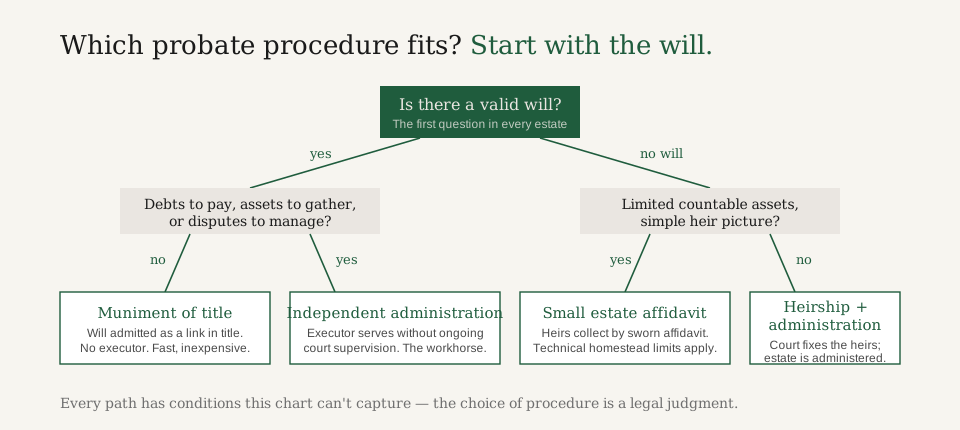
First question: which procedure fits this estate?
Independent administration
The workhorse of Texas probate. When the will requests it (or all heirs agree), the executor is appointed, files an inventory, and then administers the estate — collecting assets, paying debts, selling property, distributing to beneficiaries — without asking the court's permission for each step. Most well-drafted Texas wills make this the default, and most estates finish in a matter of months.
Muniment of title
A uniquely Texan shortcut. If there's a valid will, no unpaid debts other than those secured by real estate, and no need for a full administration, the court can admit the will to probate as a muniment — a link in the chain of title — with no executor appointed at all. The order itself transfers title. Fast, inexpensive, and ideal for estates whose main asset is the homestead.
Small estate affidavit
For intestate estates (no will) with limited countable assets, heirs can sometimes collect property by sworn affidavit approved by the court, without any administration. The rules are technical — the homestead can pass this way only to a surviving spouse or minor children who lived there.
Affidavits and determinations of heirship
When someone dies without a will, Texas intestacy law fixes who the heirs are; an affidavit of heirship recorded in the deed records, or a formal court determination, establishes it for title purposes. Blended families should pay close attention: a deceased spouse's share of community property may pass to their children, not the surviving spouse.
The four-year clock and other deadlines
A will generally must be probated within four years of death; after that, it can usually be admitted only as a muniment of title, and only with an explanation for the delay. Other timing rules matter too: creditors' notice requirements, the inventory deadline (90 days after qualification, extendable), and — where the decedent received Medicaid — the estate recovery claim process described in the long-term care guide. Delay rarely improves anything in probate.
What an executor actually does
- Files the application for probate and attends a short hearing where the will is proved and the executor qualifies by oath.
- Receives letters testamentary — the document banks and title companies require.
- Gives the required notices to beneficiaries and creditors, and publishes the creditor notice.
- Files the inventory, appraisement, and list of claims — or, where permitted, an affidavit in lieu of inventory.
- Collects assets, pays legitimate debts and final taxes, and applies the homestead and exempt-property rules that protect the family.
- Distributes to beneficiaries and documents the distributions.
Executors are fiduciaries — personally accountable for the estate. Most executor trouble comes not from bad intent but from informality: distributing early, mixing funds, or ignoring a Medicaid or IRS claim.
Assets that skip probate entirely
Life insurance, retirement accounts, payable-on-death and transfer-on-death designations, survivorship accounts, transfer-on-death deeds, Lady Bird deeds, and funded living trusts all pass outside the will. In many modern estates these non-probate transfers carry most of the value — which makes coordinating them with the will during life (see the estate planning guide) the real determinant of how smooth the estate is.
Common questions
Families ask.
Is probate required at all?
Not always. If every asset passed by beneficiary designation, survivorship, or trust, there may be nothing left for probate to do. The test is simple: is there any asset titled in the decedent's name alone that someone now needs authority to transfer?
How long does Texas probate take?
An uncontested independent administration is often substantially complete within four to eight months; a muniment of title can be done in weeks after the hearing. Contested matters, tax issues, or real estate sales extend the timeline.
The will wasn't signed with witnesses — is it worthless?
Not necessarily. A fully handwritten (holographic) will needs no witnesses in Texas, and even defectively executed wills sometimes have paths to admission. Bring the document to an attorney before concluding anything.